
News Desk · Everything Space
Simulations suggest ancient star collisions seeded early supermassive black holes
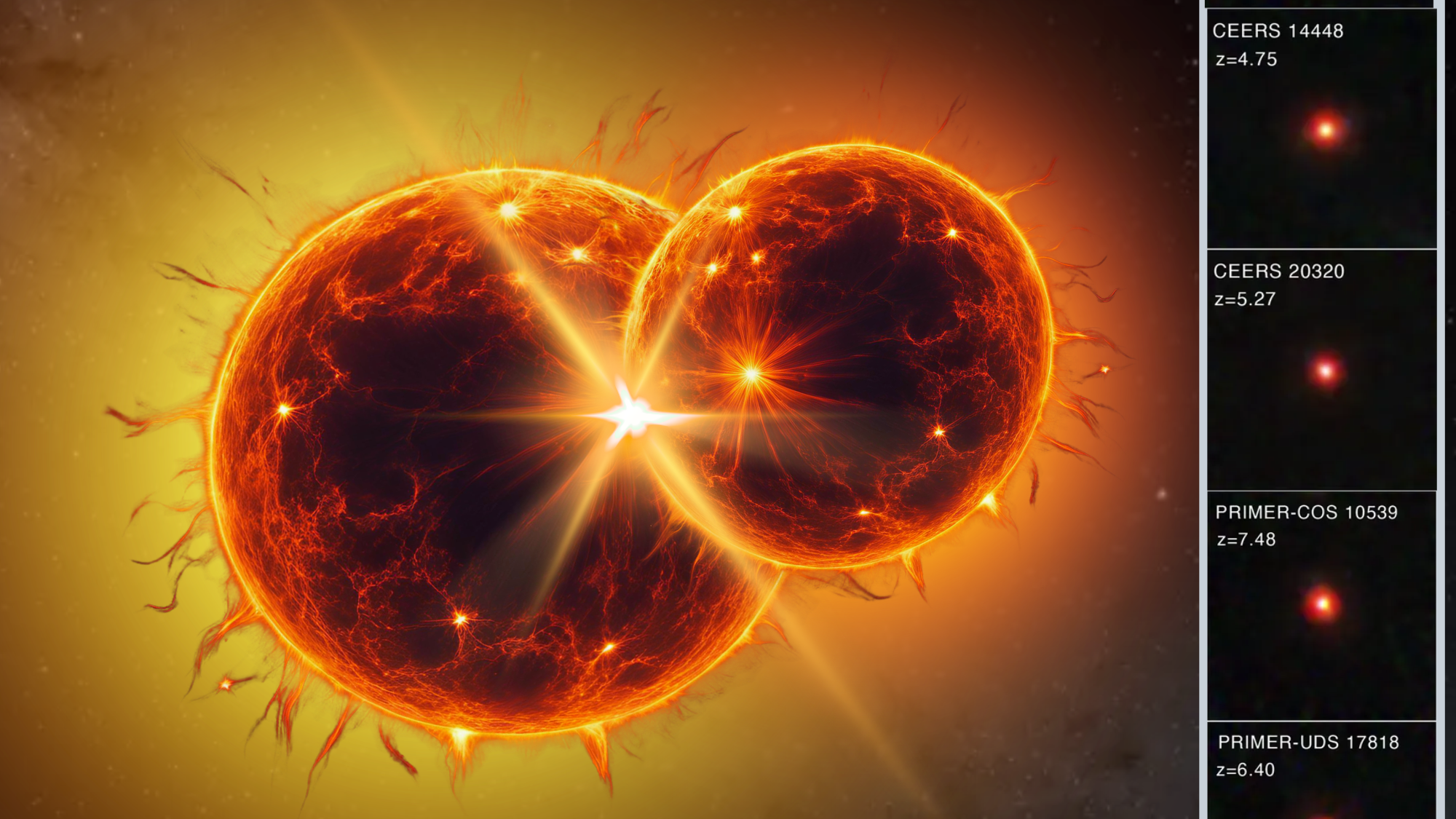
Image: Space.com
Researchers propose that dense star clusters in the early universe produced giant merged stars that collapsed into black hole seeds, possibly explaining both fast-growing black holes and JWST's Little Red Dots.
A new study using simulations of the early universe suggests that stars in young, densely packed star clusters collided with each other far more often than previously assumed. According to the researchers, slower-speed collisions allowed stars to merge repeatedly rather than being destroyed, building up a single extremely massive star within each cluster.
When such an oversized star reached the end of its life, the team's models indicate it would have had no choice but to collapse directly into a massive black hole, rather than exploding as a typical supernova. This process, the researchers argue, could provide the long-sought seeds that grew into the supermassive black holes detected by JWST in a universe less than a billion years old.
The scenario addresses a long-standing puzzle: standard models hold that growing a supermassive black hole from a normal stellar remnant should take longer than the time available in the early universe. Some scientists have proposed that black holes instead start from intermediate-mass seeds, bodies with masses between roughly 100 and 100,000 times that of the sun, since no ordinary single star is thought capable of directly producing something that massive under today's conditions. The new simulations show that in the crowded, chaotic clusters of the infant universe, such seeds could form naturally.
The same work may also help explain JWST's Little Red Dots, compact objects seen in abundance in the early universe but absent by the time the cosmos reached roughly 2 billion years old. The researchers suggest these objects could be dense star clusters undergoing repeated stellar collisions, eventually producing an intermediate-mass black hole at their core.
As the universe expanded and cooled, the chaotic clusters that gave rise to these objects evolved into the calmer, more orderly galaxies seen today, where supermassive black holes already dominate their centers and speed up orbiting stars enough to make destructive, high-velocity collisions the norm instead. That shift, the team proposes, could explain why Little Red Dots vanished once the universe moved past its most turbulent early stage.
The findings were published this week in the Astrophysical Journal.
Sources
Ancient star collisions could explain mysterious Little Red Dots and 'impossible' black holes
Written in Everything Space’s own words by our news-desk model from the sources above, and checked against them in code: every number in this report appears in its sources, and no sentence is copied from them.