
News Desk · Everything Space
New study links flare ribbon fragmentation to how the sun's magnetic fields reconnect
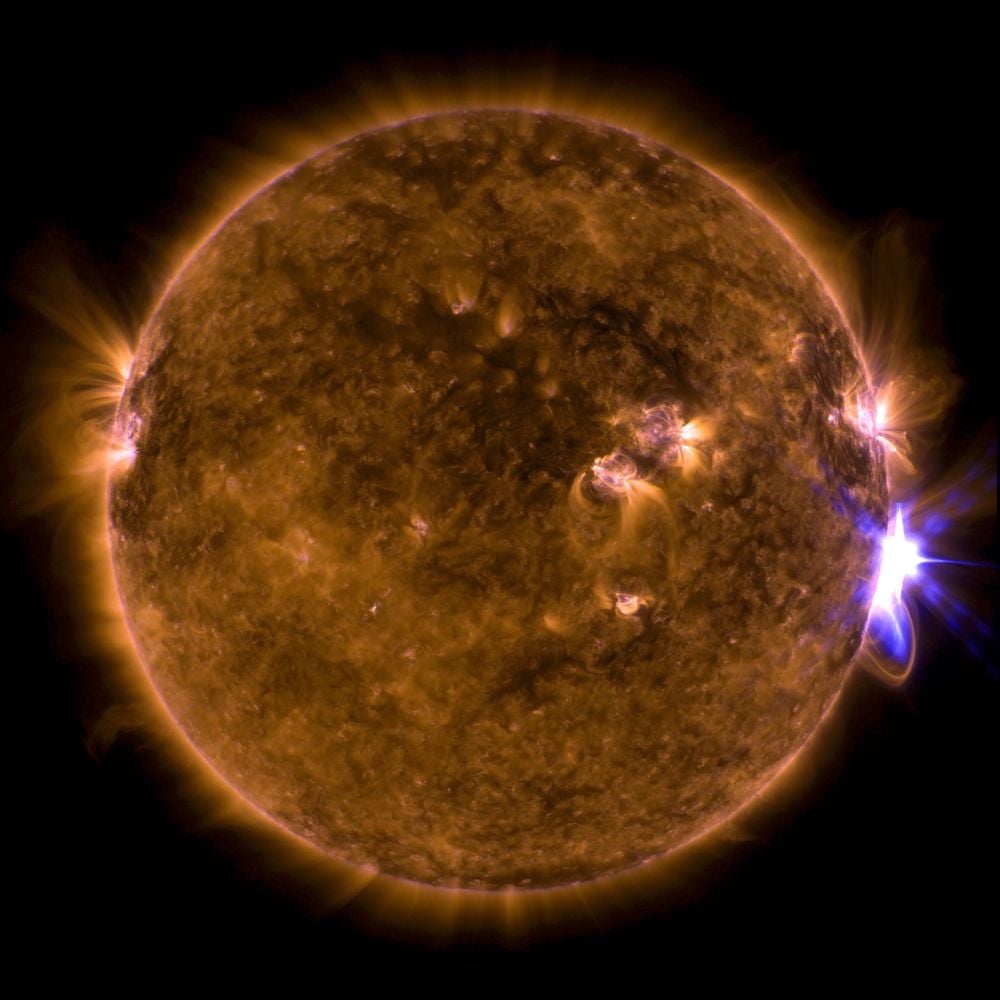
Image: Universe Today
Observational evidence tying visible flare patterns to invisible energy release above could sharpen future models of solar flares, which can disrupt power grids, GPS and spacecraft.
Researchers studying solar flares have found a way to connect visible surface patterns called flare ribbons to the hidden magnetic processes that trigger these explosions deep in the sun's corona. The work, published in The Astrophysical Journal, offers the first observational confirmation of behavior long predicted only by simulations.
Solar flares are enormous releases of energy caused by the sun's magnetic field lines twisting until they snap and reconnect into a more stable form. This reconnection process happens in the corona, a region too obscured by the sun's glare to observe directly. Flare ribbons, formed when plasma and particles generated by reconnection strike the sun's lower atmosphere, act as a kind of visible footprint of that hidden activity.
The research team, led by a scientist affiliated with the National Science Foundation and the Daniel K. Inouye Solar Telescope, developed a method to measure the fine structure and complexity of these ribbons as they evolve. They tested their approach on simulated data before applying it to a real, moderately powerful flare recorded by a NASA solar observation satellite in 2015.
The analysis showed that flares do not release their energy in one smooth burst. Instead, the ribbons break into fragments of varying sizes, depositing energy unevenly. The team found that the complexity of these fragmented shapes increased alongside the rate of magnetic reconnection, matching theoretical predictions that previously lacked direct observational support.
According to the study's authors, the irregular patterns in flare ribbons can serve as a proxy for understanding how the reconnection region above fragments and evolves, since that region itself cannot be directly imaged.
The researchers note that this work does not by itself improve the ability to forecast solar flares, which can disrupt radio communications, GPS accuracy and power grids on Earth. Instead, it strengthens the broader scientific understanding of how flares release energy, which could inform more accurate models in the future.
The study's authors describe the findings as an early step toward quantitatively linking the shapes of flare ribbons to the underlying physics of reconnection, work they say resulted from close collaboration between observation and theory.
Sources
Written in Everything Space’s own words by our news-desk model from the sources above, and checked against them in code: every number in this report appears in its sources, and no sentence is copied from them.