
News Desk · Everything Space
MeerKAT telescope detects ancient hydrogen signal using new mapping method
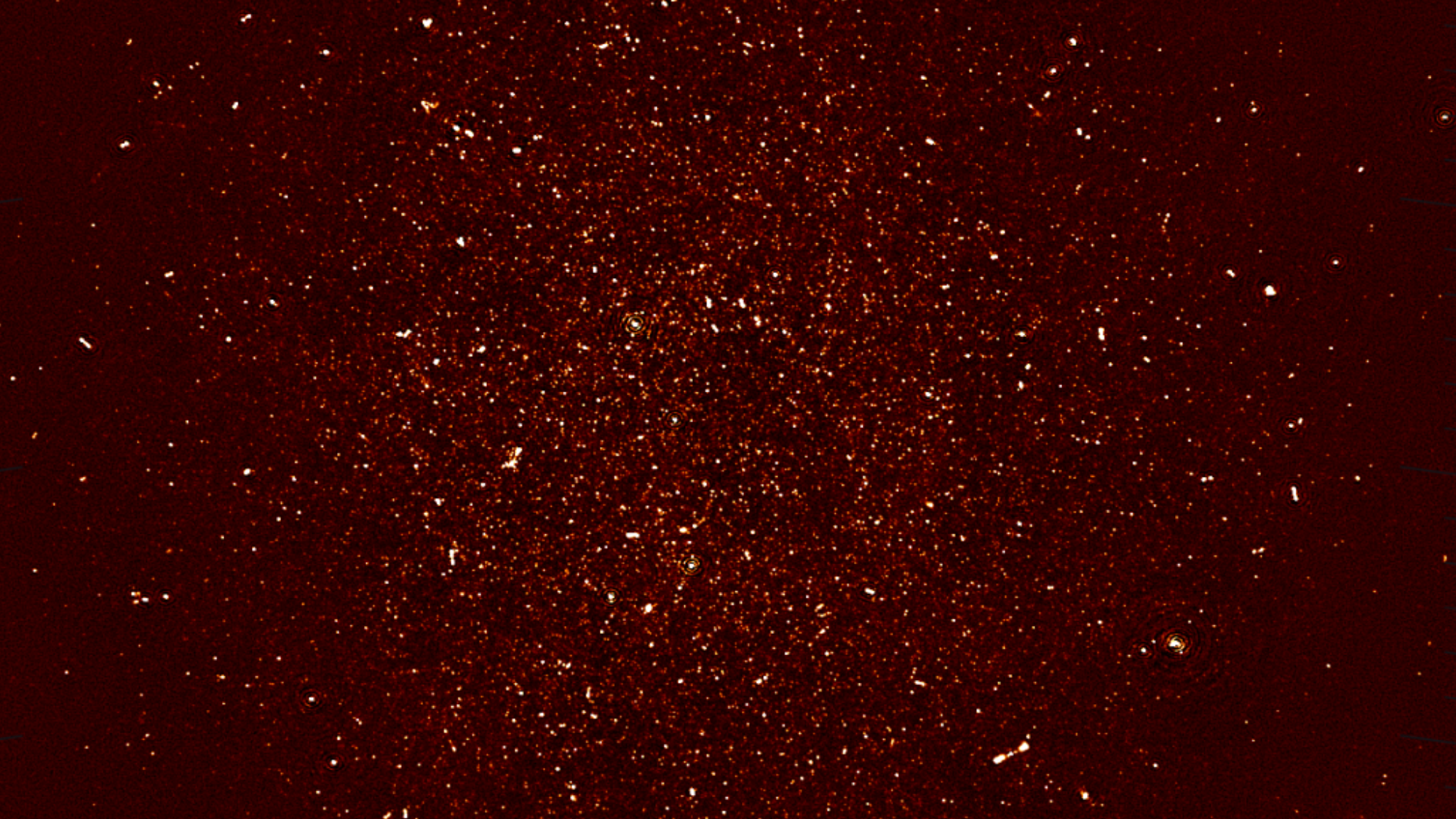
Image: Space.com
The detection shows radio telescopes alone can trace hydrogen across billions of light-years, offering a more efficient way to map the universe's structure.
Astronomers using the MeerKAT radio telescope in South Africa have picked up faint radio signals from hydrogen gas located billions of light-years away, dating back roughly 4 billion to 5 billion years into the universe's history.
The detection marks a notable step for a technique called hydrogen intensity mapping, which traces the location of hydrogen, the most common element in the universe, to build large-scale maps of cosmic structure. The method relies on the 21-centimeter radio signal naturally emitted by neutral hydrogen, which gets stretched as the universe expands, allowing scientists to gauge how far and how long ago the signal originated.
Previously, this mapping approach needed to be paired with visible-light survey data from galaxy observations to be effective. In this case, researchers achieved the detection using radio data from MeerKAT alone, which the team described as evidence the technique is maturing into a workable cosmological tool despite the difficulty of separating the weak hydrogen signal from interference and instrumental noise.
The team analyzed about 96 hours of MeerKAT observations, capturing hydrogen signals spanning distances comparable to that between the Milky Way and the Andromeda galaxy. Researchers noted that intensity mapping lets scientists study the collective signal from hydrogen across vast regions of space without needing to detect every individual galaxy, offering insight into both galaxy evolution and the broader distribution of matter.
Notably, the data behind this result was collected in 2018, shortly after MeerKAT began science operations, suggesting a large amount of existing data could still be mined using this method. The researchers plan further MeerKAT observations covering wider areas of sky over longer periods, and see the approach as a preview of what the upcoming Square Kilometre Array Observatory could accomplish for large-scale cosmic mapping.
Sources
Written in Everything Space’s own words by our news-desk model from the sources above, and checked against them in code: every number in this report appears in its sources, and no sentence is copied from them.