
SpacePolicyOnline.com · Thu, 22 Oct 2026 20:44:04 GMT
Moon’s South Pole Not the Only Compelling Location for Human Exploration
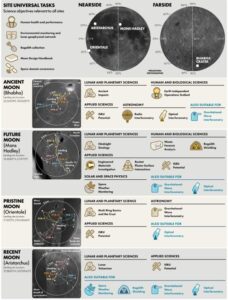
A new report from the National Academies of Sciences, Engineering, and Medicine identifies four locations on the Moon separate from the South Pole where human exploration could yield valuable scientific findings. The NASA-requested study picked one site on the farside, two on the nearside, and one on the western edge that straddles both. NASA is intent on establishing a Moon Base at the South Pole and landing astronauts there starting in 2028, but these are options for the future or if those plans change.
“ Human Exploration Across the Moon ” originated as a sister study to the Academies’ report on a science strategy for the human exploration of Mars. Its release comes just before NASA provides an update on the Artemis program, which will return American astronauts to the Moon for the first time since 1972.
Six Apollo crews landed on the nearside from 1969-1972, all comparatively close to the equator, but the Artemis program is aiming at the South Pole. Water ice deposited by comets over the eons is thought to be accessible in permanently shadowed regions there. But the Moon has many other locations of interest on both the nearside that always faces Earth and the farside that always faces away. Only the United States has landed humans on the Moon, although several countries and companies have put robotic spacecraft on the surface. Except for China, they’ve all been on the nearside.
The committee’s task was to identify locations that would benefit from investigations by human explorers, not just robots, between the latitudes of 84 degrees north and 84 degrees south, yielding scientific results of the caliber expected from the Decadal Surveys produced by the Academies even 10 years (a decade) for NASA’s five science disciplines: astrophysics, biological and physical sciences, earth science, heliophysics, and planetary science.
From a long list of possibilities, the committee found four that stood out. In priority order they are: Bhabha Crater, Mons Hadley, Orientale Basin, and Aristarchus Plateau. The committee labeled them Ancient Moon, Future Moon, Pristine Moon, and Recent Moon to highlight their distinctive contributions to science.
At an October 21 briefing, committee co-chairs James Day and Dan Dumbacher stressed their task was to assess locations that would specifically benefit from human explorers rather than robots. For example, Hadley Rille, a large “incredible structure” that likely is a collapsed lava tube, is too risky for astronauts. Day is a professor of geology at the University of California San Diego. Dumbacher is professor at Purdue University and a former NASA and AIAA executive.
NASA is focused on the South Pole and it’s not clear when or if the agency might embark on exploration of other locations. Dumbacher said the study provides “a solid case of science objectives and locations that NASA can factor into their planning,” but it’s up to the agency to decide when and where to go.
The South Pole is a challenging location, with steep slopes, low Sun angles, and temperature extremes. The attraction is the potential of extracting the water ice and using it to support human outposts or create propellant for rockets travelling further into space.
Not everyone is convinced it’s the best target for landing astronauts for the first time in more than 50 years, however. Having seen the Moon close up on the Artemis II mission in April, astronaut Victor Glover said at the NASA Exploration Science Forum in July that he thinks a site nearer the equator might be a better first choice.

In a public summary today of its most recent quarterly meeting, NASA’s Aerospace Safety Advisory Panel (ASAP) agreed that Artemis IV involves a large number of firsts and they will be opening a new formal recommendation expressing some concerns.
“We’re going to recommend that NASA re-examine the mission objectives, potentially the system architecture for Artemis IV and the subsequent missions, to establish a more balanced approach to risk, prioritize the objectives-driven planning, and maintain a consistent cadence of flight missions.
“For every test objective, including objectives related to uncrewed demonstration missions by the lander system coming from the service providers, NASA should develop a detailed plan for testing and data collection, incorporating both ground and flight tests to ensure that all risks are thoroughly identified and mitigated. This structured approach will provide a more balanced sequence of flight tests, ultimately supporting a successful crewed lunar landing and the creation of a sustainable lunar base.” — ASAP Member Charlie Precourt, former NASA astronaut
NASA officials will give an update on the Artemis program tomorrow afternoon. NASA reformulated the program earlier this year. Instead of landing on the Moon, the next mission, Artemis III, will be an earth-orbital flight to practice rendezvous and docking with test articles of the Human Landing Systems being built by SpaceX and Blue Origin. That’s next year, followed by the first Artemis human landing on Artemis IV in 2028 under the current plan.
Reported by SpacePolicyOnline.com. Reproduced unedited by Everything Space. View the original →
What do you make of it?
Nobody has weighed in on this story yet.